Threat analysis of ransomware: methods, risks, and protection
Threat analysis of ransomware helps to understand where the organization is vulnerable, which attack scenarios are most likely, and which protective measures will provide the best effect. Ransomware blocks data and systems and then demands a ransom. However, modern attacks rarely stop at encryption. Often, attackers steal data, pressure businesses through customers and partners, and try to destroy backups. In this article, we will explore a practical approach to risk assessment, indicators of attack, preventive measures, and response plans.

Why the threat of ransomware remains critical
Ransomware is malware that makes files, servers, or workstations inaccessible. It typically encrypts data and leaves instructions for contacting the attackers. But the real threat is broader. An incident can halt sales, production, logistics, accounting, customer support, and internal communications.
The main danger of ransomware is that an attack affects not only the IT department. It quickly becomes a business crisis. Management has to make decisions about downtime, notifying customers, restoring from backups, legal risks, and communications with regulators.
Moreover, ransomware operators use multi-layered pressure schemes. For example, they can:
- Encrypt data and demand ransom for the key;
- Steal documents and threaten publication;
- Attack backups and monitoring systems;
- Use stolen accounts for re-entry;
- Spread across the network through shared folders, RDP, VPN, or administration tools;
- Connect DDoS or public pressure as an additional lever.
Thus, threat analysis of ransomware must assess not only the malicious file but the entire attack path: from initial access to business recovery.
How ransomware enters infrastructure
To reduce risk, one needs to understand common entry points. Most attacks do not start with complex exploits but with a combination of weak settings, stolen credentials, and insufficient control.
Phishing and social engineering
A phishing email may contain a malicious attachment, a link to a fake login page, or a document with macros. Sometimes, attackers engage in correspondence for several days to build trust. The goal is simple: to obtain credentials or to launch a malware loader.
To protect against this, email filtering, employee training, prohibiting unsafe attachments, file sandboxes, and multi-factor authentication are needed. However, it is important not to shift all responsibility onto the user. Even a trained employee can make mistakes.
Vulnerable external services
A common cause of incidents is open RDP, administration panels, VPN gateways, web applications, and outdated servers exposed to the outside. If patches are not applied in a timely manner, and access is protected only by a password, an attacker gains an easy entry point.
The minimum set of measures includes inventory of the external perimeter, regular vulnerability scanning, restricting access by IP, MFA, updates, and disabling unnecessary services.
Credential compromise
Passwords fall into attackers' hands through phishing, leaks, malware on home devices, password reuse, and brute-forcing. Once inside the network, attackers look for privileged accounts, domain administrators, service accounts, and access tokens.
Therefore, identity management is a key element of protection against ransomware. MFA, the principle of least privilege, separate accounts for administration, monitoring of anomalous logins, and regular checks of permissions are necessary.
Supply chain and trusted tools
Sometimes the attack happens through a contractor, software update, integrator's remote access, or management system. In such cases, malicious actions appear legitimate because they are conducted through authorized channels.
It is essential to vet suppliers, limit their access, maintain an action log, apply temporary accounts, and segregate network zones. Trust should not mean unrestricted access.
What does ransomware threat analysis include
Good ransomware threat analysis is not a single report or a formal table. It is a process that connects technical vulnerabilities with business consequences. Its goal is to answer five questions:
- What assets are critical for the organization’s operation?
- How can an attacker gain access to them?
- What protective measures are already in place and how effective are they?
- What damage will occur due to encryption, data theft, or downtime?
- What measures should be implemented first?
The analysis includes asset inventory, attack modeling, damage and probability assessment, backup verification, log analysis, response process evaluation, and restoration testing.
It is important to consider different scenarios. For example, encrypting a file server and compromising a domain controller requires different measures. An attack on one laptop can be a localized problem. But if the attacker gains domain administrator rights, the entire infrastructure is at risk.
Step-by-step approach to ransomware risk assessment
Below is a practical algorithm that can serve as a basis for internal audits or preparation for an audit.
-
Identify critical business processes. Create a list of processes whose stoppage would lead to significant damage. For example, order processing, production, storage, payments, customer support, medical records, or accounting.
-
Link processes to IT assets. For each process, specify the servers, databases, applications, workstations, network devices, cloud services, and external providers. This will show which systems need to be protected first.
-
Describe possible entry points. Examine email, VPN, RDP, web applications, remote contractor access, cloud accounts, mobile devices, and public repositories. Highlight services without MFA separately.
-
Assess privileges and segmentation. Check who has administrative rights, where shared accounts are used, which servers are accessible from user segments, and whether one workstation can reach critical resources.
-
Verify backups. Clarify what is being copied, how often, where it's stored, who has access, and whether data can be restored without the primary network. Copies must be protected against deletion and encryption.
-
Analyze logs and detection. Ensure that logins, privilege escalations, mass file changes, disabling protective measures, launching suspicious scripts, and anomalous administrator activity are recorded.
-
Assess attack impact. For each scenario, identify potential downtime, data loss, contractual violations, legal consequences, reputational damage, and recovery costs.
-
Prioritize. First, address risks where high probability intersects with significant damage. For instance, an external VPN without MFA or backups accessible from the domain usually require immediate attention.
-
Conduct drills. Simulate an incident: who makes decisions, who disables network segments, who communicates with management, who checks backups, and who interacts with lawyers and external experts.
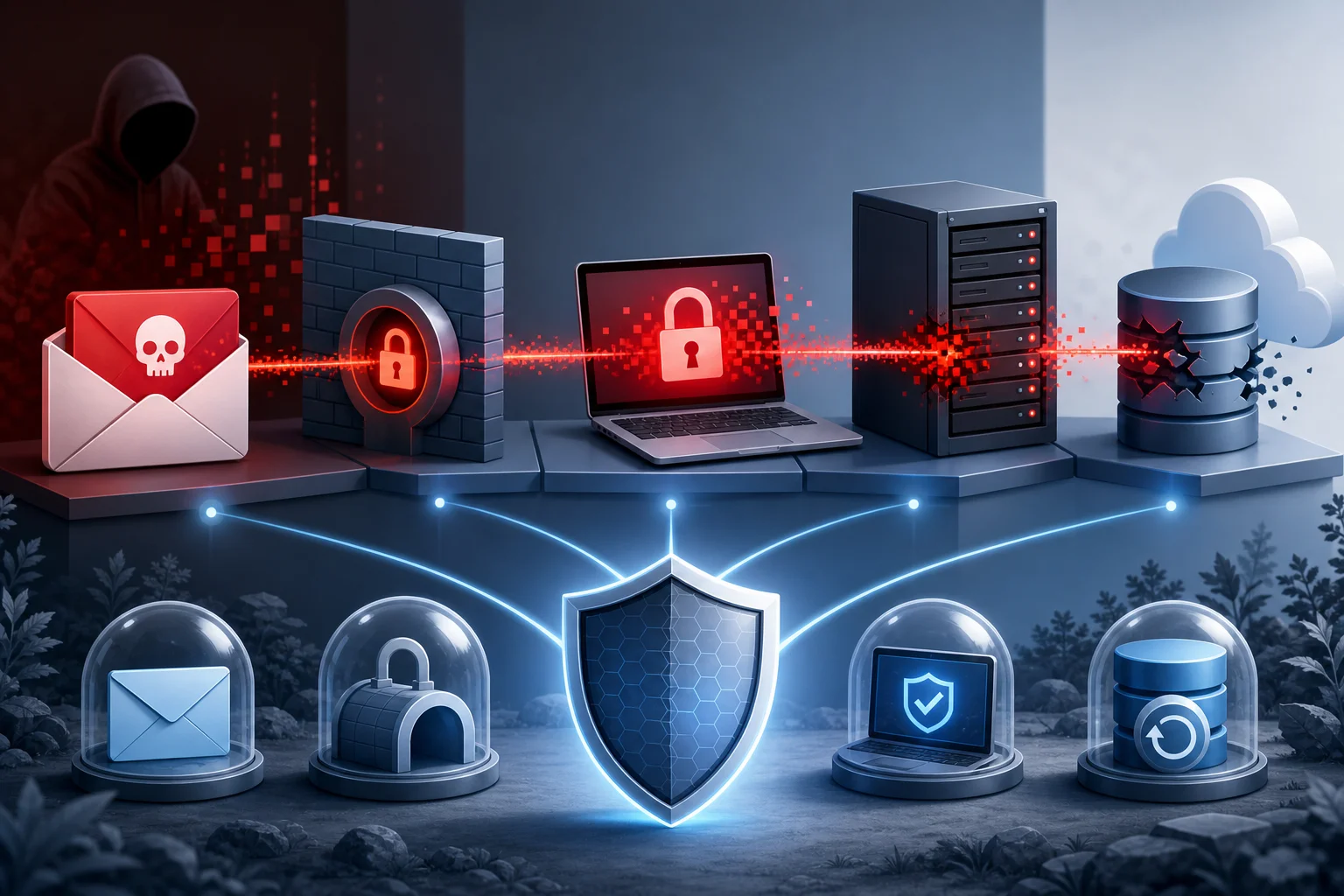
Risk matrix for ransomware threats
The matrix helps compare scenarios and choose protective measures. It does not replace technical analysis but makes risks understandable for management.
| Threat scenario | Probability | Potential damage | Priority measures |
|---|---|---|---|
| Phishing with password theft | High | Medium or high | MFA, email filtering, training, login monitoring |
| VPN breach without updates | Medium or high | High | Patches, MFA, access restriction, configuration audit |
| File server encryption | Medium | High | EDR, segmentation, rights control, immutable copies |
| Compromise of a domain administrator | Medium | Critical | PAM, separation of admin accounts, AD monitoring, least privilege principle |
| Deletion of backups | Medium | Critical | Isolated and immutable copies, separate accounts, recovery testing |
| Attack through a contractor | Low or medium | High | Access restriction, logging, temporary rights, security contract requirements |
| Theft of personal data before encryption | Medium | High | DLP, data classification, storage encryption, export control |
After filling in the matrix, it makes sense to add a risk owner and a timeline for elimination. Without accountable individuals, even a solid analysis becomes a wishlist.
Indicators of compromise and early signs of an attack
Ransomware usually appears at the final stage. Prior to this, attackers may study the network for days or weeks, escalating privileges and preparing for launch. Therefore, early detection significantly reduces damage.
Technical indicators
Signs of possible preparation for an attack include:
- Logins from unusual countries, networks, or at non-standard times;
- Multiple failed login attempts on VPN, RDP, or email;
- Creation of new administrative accounts;
- Disabling antivirus, EDR, logging or backup;
- Launching PowerShell, PsExec, WMI, or other administrative tools from atypical workstations;
- Extensive network scanning and enumeration of domain resources;
- Sudden increase in file read and write activities on file servers;
- Appearance of archives with large volumes of data prior to external transmission;
- Connections to suspicious domains or command servers;
- Changes to security policies in Active Directory.
Not every point indicates ransomware. However, a combination of several signs requires investigation. Events related to disabling protection and accessing backups are particularly dangerous.
Organizational signs
There are also less technical signals. For instance, employees complaining about slow file folder operations, unexpected document locks, MFA requests they did not initiate, or strange emails from internal addresses. A contractor may urgently request extended access. An administrator may notice unknown scheduled tasks.
To ensure these signs are not lost, a simple incident reporting procedure is needed. Employees should know where to report or call if they see suspicious activity. The response must be swift and without blame.
Protective measures against ransomware
Protection against ransomware is layered. One cannot rely solely on antivirus, backups, or training. If one barrier fails, the next should slow down the attack and provide time for response.
Prevention of initial access
Start with the external perimeter and email. Remove unnecessary open services, enable MFA for VPNs, email, administrative panels, and cloud applications. Configure DMARC, DKIM, and SPF to reduce domain spoofing risk. Update VPNs, gateways, web servers, and remote access systems.
For workstations, it is beneficial to prohibit macros from the internet, control script execution, limit local administrators, and manage applications. The fewer opportunities malware has to run, the lower the risk of spreading.
Network segmentation and privilege limitation
If a user's computer can directly connect to critical servers, an attack spreads faster. Segmentation divides workstations, servers, backup systems, industrial networks, guest networks, and administrative zones.
The principle of least privilege reduces the aftermath of compromise. A user should not have more rights than necessary for work. Administrative rights are better granted through separate accounts, temporarily, and with logging. Service accounts should have complex passwords, limited rights, and interactive login restrictions unless needed.
Backup and recovery
Backups are the last line of defense, but only if they can actually be restored. It is not enough to see a successful job status in the console. Regular test restorations are necessary.
Backup protection practices include:
- Storing copies in a separate security zone;
- Immutable copies that cannot be deleted or altered until the retention period expires;
- Separate accounts for the backup system;
- No permanent domain admin access to the storage of copies;
- Offline or cloud copies with strict access policies;
- Documented RPO and RTO for critical systems;
- Regular application recovery tests, not just individual files.
RPO indicates how much data the business is willing to lose over time. RTO indicates how quickly operations must be restored. These parameters should be agreed upon with management, not just IT.
Detection and response
EDR, SIEM, NDR, and cloud service logs help identify suspicious activity. But the tools must be configured. It is crucial to collect events from domain controllers, servers, workstations, VPNs, email, backup systems, and critical applications.
Useful detection rules include:
- Mass renaming or modification of files;
- Launching suspicious PowerShell commands;
- Disabling protective agents;
- Unusual admin logins;
- Accessing a large number of network resources in a short time;
- Exporting large volumes of data;
- Changing domain policies;
- Attempts to delete shadow copies or backup jobs.
However, technology does not replace the process. It is important to pre-determine who receives alerts, how quickly they are reviewed, and when an incident is escalated.
Ransomware attack response plan
When encryption has already started, time becomes the most critical resource. A concise and clear plan is needed that can be executed under pressure.
-
Document indicators of the incident. Record the time, affected systems, screen messages, file names, suspicious accounts, and last actions. Do not delete artifacts unnecessarily.
-
Isolate infected devices. Disconnect them from the network or quarantine them. Do not shut down everything indiscriminately, as memory and logs may be important for investigation.
-
Limit propagation. Temporarily disable shared folders, block suspicious accounts, stop compromised VPN sessions, and restrict access between segments as planned.
-
Protect backups. Verify that deletions or encryptions of copies are not occurring. Disable access to storage if there is a risk of compromise. Do not begin recovery in an infected environment.
-
Establish an incident management team. Include IT, security, legal, management, communications, and business process owners. Appoint a single coordinator.
-
Conduct an investigation. Determine the entry point, scope of compromise, affected accounts, data leakage, and whether attackers still have access.
-
Restore a clean environment. First, close the entry point and change credentials. Then restore systems from verified copies. Deploy a separate environment if necessary.
-
Document decisions. Record actions, time, responsible persons, and rationales. This is important for subsequent analysis, insurance matters, legal procedures, and improving protection.
Do not rush to pay the ransom. Payment does not guarantee recovery, does not eliminate the cause of the breach, and may lead to subsequent attacks. The decision should only be made after consulting with lawyers, response experts, and, if necessary, competent authorities.

Features of analysis for small and medium-sized businesses
Small companies often believe they are not interesting to attackers. This is a dangerous misconception. Ransomware operators use automated searches for vulnerable systems and sell access to other groups. The size of the business is not always crucial. What matters more is how easily access can be obtained and money can be made.
For small businesses, priority should be given to simple measures with high impact:
- MFA for email, VPN, and administrators;
- Reliable backups with recovery testing;
- Updates for workstations and servers;
- Disabling open RDP from the internet;
- Antivirus or EDR with centralized management;
- Separate accounts for administration;
- A basic response plan on one page;
- Employee training to recognize phishing.
Medium-sized businesses should consider adding SIEM or managed monitoring, network segmentation, regular vulnerability scanning, Active Directory audits, and recovery drills. If the internal team is lacking, they can engage MSSP or incident response specialists.
Mistakes that amplify damage
Even with protective tools in place, organizations often make recurring mistakes.
The first mistake is storing backups in the same domain zone and with the same rights as primary servers. If an attacker gains administrator rights, they can destroy both the originals and copies.
The second mistake is not verifying recovery. A backup that no one has restored is an assumption, not a guarantee.
The third mistake is using shared administrator accounts. In such cases, it is difficult to understand who did what, and compromising one password opens up too many possibilities.
The fourth mistake is assuming that the cloud automatically protects against ransomware. Cloud services also require MFA, rights control, logging, backup, and storage policy configurations.
The fifth mistake is reacting chaotically. In the first hours of an incident, teams may interfere with each other: someone is rebooting servers, someone is deleting files, someone is restoring data in an infected network. A response plan reduces chaos.
How to check readiness for an attack
Readiness checks should be regular. Ideally, conduct brief self-assessments once a quarter and more thorough audits at least once a year or after significant infrastructure changes.
Use the following checklist questions:
- Is there an up-to-date map of critical systems and data owners?
- Is MFA enabled for all external and privileged accesses?
- Are there exposed RDPs, control panels, or outdated VPNs?
- Have backups been verified for restoration in the past months?
- Are backups protected against deletion and encryption?
- Are the rights of local and domain administrators restricted?
- Are logs collected from key systems?
- Are there alerts for mass file changes and disabled protections?
- Do employees understand where to report suspicious emails?
- Have ransomware scenario drills been conducted?
If the answer to several questions is negative, it is not a reason to panic. It is a basis for an improvement plan. Start with risks that provide attackers a quick path to critical assets.
FAQ: frequently asked questions about ransomware threat analysis
What is ransomware threat analysis in simple terms?
It is the assessment of how ransomware might enter an organization, which systems it could affect, what the damage would be, and what measures need to be implemented to reduce the likelihood of an attack and expedite recovery.
How does ransomware differ from a regular virus?
A regular virus can perform various malicious actions. Ransomware specifically makes data inaccessible and demands a ransom. Modern groups often also steal data prior to encryption.
Should I pay the ransom during a ransomware attack?
Payment does not guarantee decryption and does not eliminate the cause of the breach. Before making any decisions, the incident should be isolated, the scale assessed, backups checked, and consultations with lawyers and response experts conducted.
Which systems should be prioritized for protection?
First, protect email, VPN, admin accounts, domain controllers, file servers, backup systems, databases, and applications critical to business processes.
How often should recovery from backups be tested?
The frequency depends on the criticality of the systems. For key services, tests should be conducted regularly and after infrastructure changes. It is important to verify not just files but also the full launch of applications.
Will antivirus fully protect against ransomware?
Antivirus reduces risk but does not provide full protection. MFA, updates, segmentation, privilege control, monitoring, backups, and a prepared response plan are all necessary.
Conclusion
Ransomware threat analysis should be practical, linked to business needs, and regularly updated. Start with critical processes, check entry points, implement MFA, protect backups, limit privileges, and prepare a response plan. Then conduct drills and address the most dangerous gaps. The sooner an organization identifies weak spots, the higher the chance of stopping an attack before encryption and restoring operations without significant damage.