Retroviruses: their features and differences from other viruses
Retroviruses, their features and differences from other viruses are important not only for virologists but also for doctors, students, biologists, and anyone who wants to understand how some chronic infections develop. The main feature of retroviruses is that they carry genetic information in the form of RNA, but after infecting a cell, they rewrite it into DNA and integrate it into the host genome. This allows the infection to persist for a long time, and treatment often aims not at complete removal of the virus but at controlling its replication.
What are retroviruses
Retroviruses are a family of RNA-containing viruses that belong to Retroviridae. Their name is associated with the unusual direction of genetic information transfer. In the classical scheme of biology, DNA serves as a template for RNA synthesis, while RNA serves as a template for protein synthesis. In retroviruses, part of the process goes “backwards”: the viral RNA is first converted into DNA using the enzyme reverse transcriptase.
After that, the viral DNA is integrated into the DNA of the infected cell. This integrated form is called a provirus. The provirus can remain in the cell for a long time, replicate along with its genome, and under certain conditions, generate new viral particles again.
Different groups of viruses fall under retroviruses. The most well-known example is HIV, the human immunodeficiency virus. This family also includes human T-lymphotropic viruses or HTLV, and in animals—viruses associated with immunodeficiencies, tumor processes, and other diseases.
It is important to understand: a retrovirus is not synonymous with HIV. HIV is a retrovirus, but not every retrovirus is HIV.
Key features of retroviruses
Retroviruses are distinguished from many other viruses not by one characteristic but by a whole set of properties. These features determine their life cycle, behavior in the body, and treatment approaches.
RNA genome and reverse transcription
The genetic material of retroviruses is represented by single-stranded RNA. However, for stable existence in the cell, the virus translates this RNA into DNA. This is the responsibility of the enzyme reverse transcriptase.
This enzyme makes the infection process special. It creates a DNA copy of the viral genome but operates less accurately than many cellular DNA copying enzymes. Therefore, mutations often occur during retrovirus replication. This is one reason for the genetic variability of HIV and the emergence of variants that differ in drug sensitivity.
Integration into the host cell genome
After reverse transcription, the viral DNA does not remain just as a separate molecule. It is transported to the nucleus and integrated into the cell's genome by the enzyme integrase. The integrated viral DNA is called provirus.
Integration has several consequences:
- viral information is preserved in the cell for an extended period;
- during cell division, the provirus may be passed on to daughter cells;
- the immune system has a harder time detecting a completely “silent” provirus;
- eliminating all cells with provirus is extremely difficult.
This is why some retroviral infections can become chronic.
Presence of a viral envelope
Retroviruses are enveloped viruses. Their outer envelope is formed from the membrane of the host cell when a new viral particle buds off from the cell. This envelope contains viral proteins that help attach to new cells and penetrate inside.
The envelope makes retroviruses sensitive to drying, heating, alcoholic disinfectants, and cleaning agents. Therefore, outside the body, such viruses are usually less stable than many non-enveloped viruses, such as certain intestinal viruses.
High variability
Retroviruses often accumulate mutations. The reason is the peculiarities of reverse transcription and high replication speed in active infections. For HIV, this is particularly important: different virus variants can differ in drug sensitivity and ability to evade the immune response.
However, variability does not mean that the virus changes endlessly and chaotically without restrictions. Any mutation undergoes selection. If it hinders the virus's replication, that variant usually does not stabilize. If it helps survive in the conditions of immune response or drug pressure, it may become more prominent.
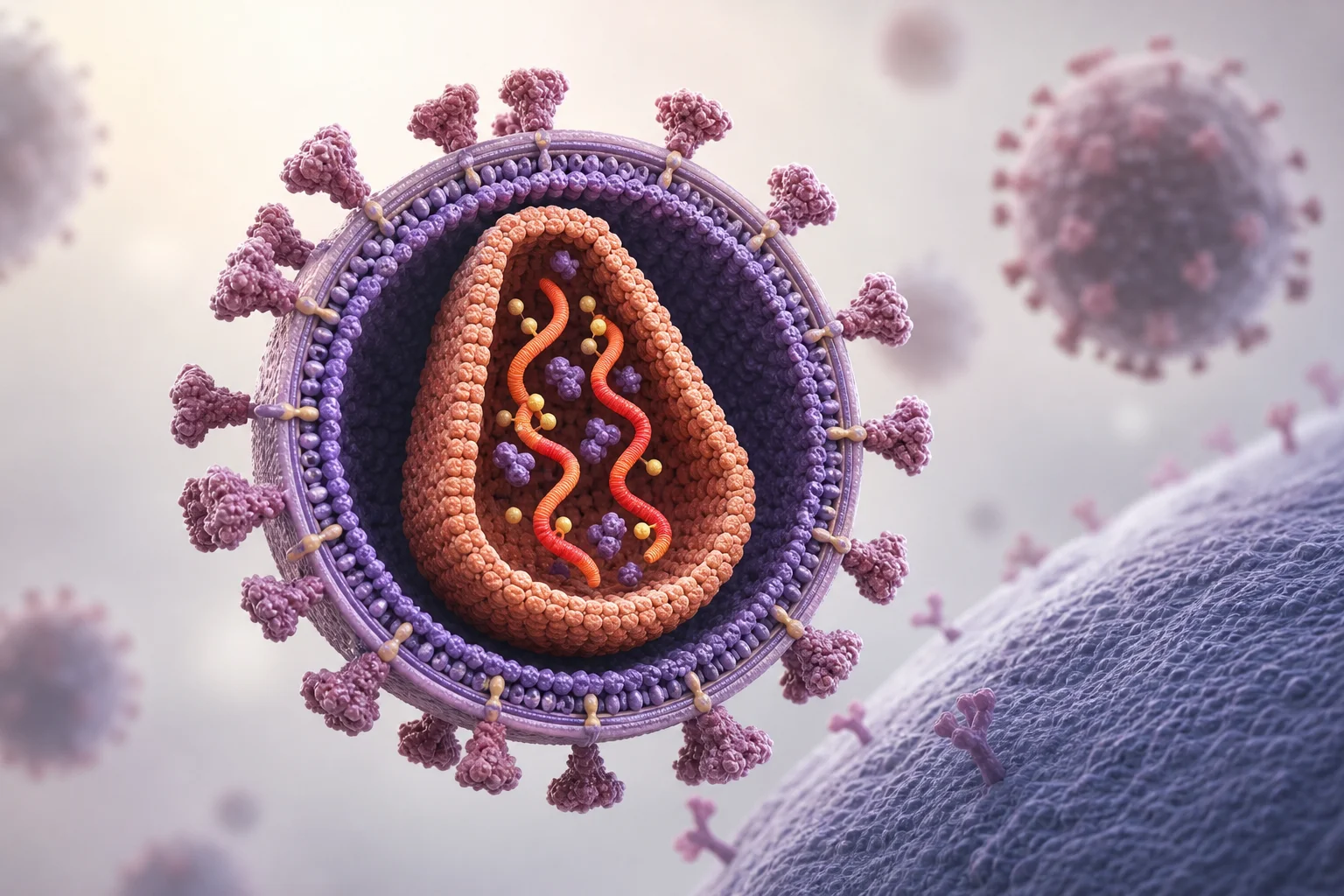
Structure of the viral particle
The structure of a retrovirus is dictated by its life cycle. Despite differences among species, most representatives of the family share common elements.
The main components of a retrovirus particle are:
- envelope—a lipid membrane with viral glycoproteins;
- capsid—a protein structure that protects genetic material;
- two copies of RNA genome—a significant feature of retroviruses;
- reverse transcriptase—the enzyme for synthesizing DNA from an RNA template;
- integrase—the enzyme for integrating viral DNA into the host cell genome;
- protease—the enzyme needed for the maturation of the viral particle.
The genome of a typical retrovirus contains several key genes. gag encodes structural proteins, pol encodes enzymes, including reverse transcriptase, integrase, and protease, while env encodes envelope proteins. Complex retroviruses like HIV have additional regulatory genes that help manage the virus's replication and interaction with the cell.
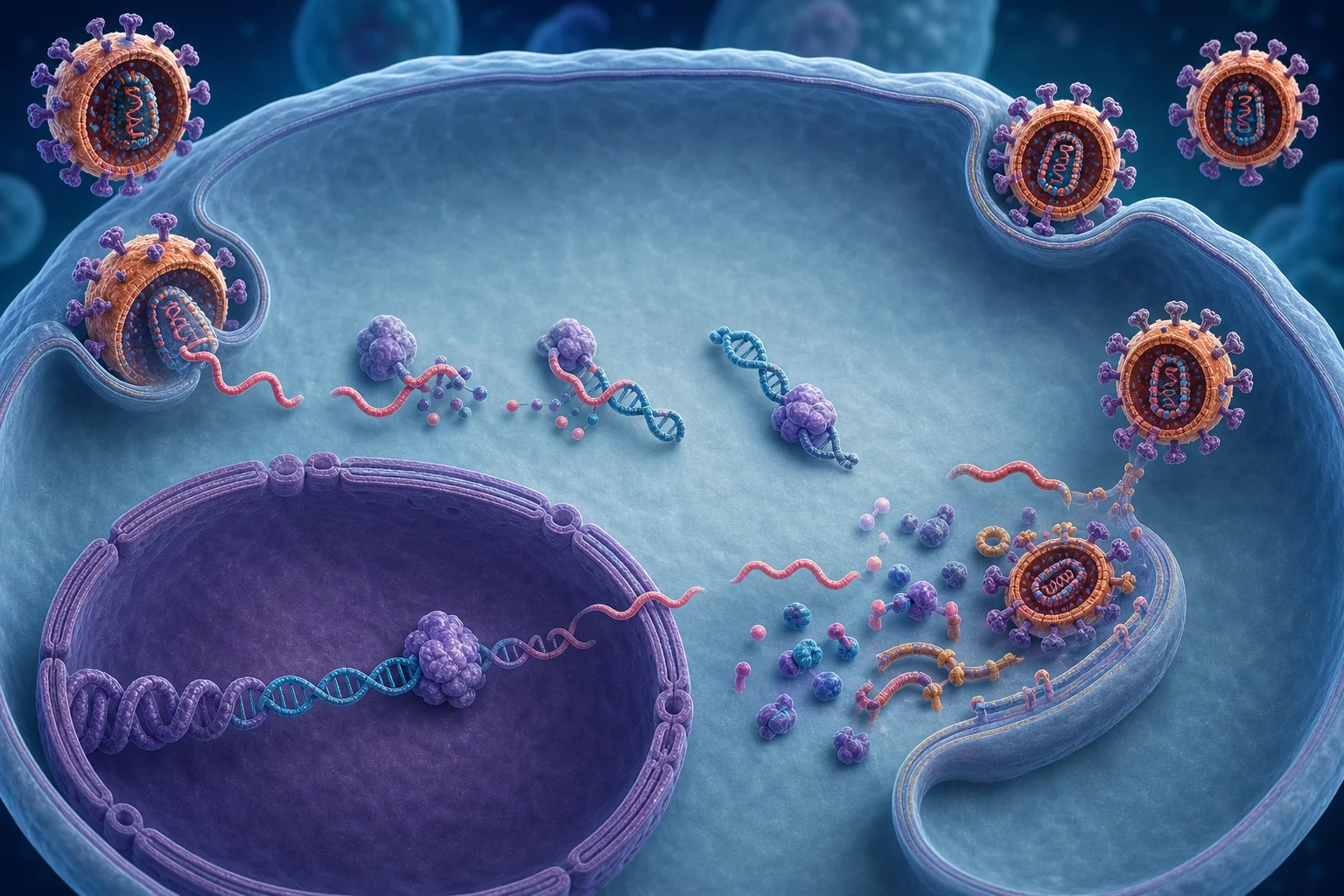
Life cycle of a retrovirus step by step
Below is a simplified sequence of events that helps understand how retroviruses differ from other viruses.
- Attachment to the cell. Viral envelope proteins recognize specific receptors on the cell surface.
- Entry. The viral envelope fuses with the cell membrane, or the virus enters the cell by another means, after which the capsid is inside.
- Reverse transcription. The viral RNA is transcribed into DNA using reverse transcriptase.
- Transport to the nucleus. The complex with viral DNA moves to the cell nucleus.
- Integration. Integrase integrates the viral DNA into the host genome, forming a provirus.
- Synthesis of viral RNAs and proteins. Cellular mechanisms begin to read the proviral DNA.
- Assembly of new particles. Viral components assemble at the cell membrane.
- Budding. The new viral particle exits the cell, acquiring an envelope.
- Maturation. The viral protease cleaves protein precursors, and the particle becomes infectious.
This scheme shows why different intervention points can be used for retroviral infection therapy. For example, drugs can block reverse transcriptase, integrase, protease, or the virus's entry into the cell.
How retroviruses differ from other viruses
The main difference of retroviruses is the mandatory formation of a DNA copy based on RNA and its integration into the host cell genome. However, to fully understand, it is helpful to compare retroviruses with other groups of viruses.
| Feature | Retroviruses | Many other RNA viruses | DNA viruses |
|---|---|---|---|
| Genetic material | RNA | RNA | DNA |
| Mandatory reverse transcription | Yes | Usually no | No, except for specific groups with reverse transcription |
| Integration into the host genome | Key part of the cycle | Usually unnecessary | Possible for some, but not universal |
| Long-term hidden preservation | Often possible | Depends on the virus | Possible for a range of viruses |
| Key therapeutic target enzymes | Reverse transcriptase, integrase, protease | RNA polymerases, proteases, and other proteins | DNA polymerases and other proteins |
| Example | HIV, HTLV | Influenza, coronaviruses, measles virus | Herpesviruses, adenoviruses, papillomaviruses |
Difference from regular RNA viruses
Many RNA viruses replicate without integrating into the cell genome. For example, influenza viruses and coronaviruses use their RNA-dependent enzymes to create new RNA copies. They can cause acute infections, although the course depends on the specific virus and the body's condition.
Retroviruses act differently. They convert RNA into DNA and then integrate it into the cellular genome. Thus, the infection can obtain a stable intracellular form.
Difference from DNA viruses
DNA viruses already carry genetic material in the form of DNA. They do not need to go through a reverse transcription stage. Some DNA viruses can persist in cells for a long time, such as herpesviruses. However, their latency mechanisms differ from retroviral integration.
There are also specific viruses that use reverse transcription but are not classified as retroviruses. For example, the hepatitis B virus is a DNA virus with reverse transcription in its life cycle. Thus, the presence of reverse transcriptase alone does not make a virus a retrovirus. The overall cycle, genome structure, and belonging to the Retroviridae family are important.
Difference from bacteriophages
Bacteriophages infect bacteria, not human or animal cells. Some phages can also integrate their genetic material into the bacterial genome. But this is a different biological world: different target cells, different structures, and different interaction mechanisms.
Retroviruses infect eukaryotic cells of animals and humans. Their enzymes, envelope, and maturation processes are specifically related to such cells.
Why retroviral infections are difficult to eliminate completely
Retroviruses are complex for complete removal from the body due to the proviral form. When viral DNA is integrated into the cell's genome, it becomes part of the cell's DNA. If the provirus is inactive, the immune system may not see the infected cell as dangerous.
This is particularly well studied in the context of HIV. Modern antiretroviral therapy can effectively suppress the virus's replication. With the correct intake of medications, the viral load can become undetectable by standard tests. However, hidden reservoirs of cells with provirus can persist. Therefore, therapy should not be discontinued without a doctor's recommendation.
Difficulties are related to several factors:
- provirus is located within the cell's DNA;
- some infected cells can live long;
- the virus can change rapidly;
- the immune system does not always recognize latent infection;
- different tissues can serve as reservoirs for the virus.
At the same time, medicine is not stagnant. Strategies targeting latent reservoirs, gene technologies, new antibodies, and vaccine approaches are being explored. However, in clinical practice, the foundation of HIV control remains regular antiretroviral therapy prescribed by a specialist.
HIV as the most well-known retrovirus
HIV belongs to lentiviruses—a group of retroviruses that often cause slowly progressing infections. The main target of HIV is the immune system cells, primarily CD4-positive T-lymphocytes. The virus can also interact with other cells that have suitable receptors and coreceptors.
Without treatment, HIV infection can gradually damage the immune system and lead to acquired immunodeficiency syndrome. However, with timely diagnosis and appropriately selected therapy, a person can maintain quality of life for a long time and reduce the risk of transmitting the virus.
It is important to differentiate between two concepts:
- HIV—the virus that causes the infection;
- AIDS—the late stage of HIV infection associated with severe immunodeficiency.
Not every person with HIV has AIDS. Modern treatments aim to prevent disease progression.
Other human and animal retroviruses
While HIV is the most recognized, it is not the only retrovirus.
HTLV
HTLV, or human T-cell leukemia virus, also belongs to retroviruses. Some types of HTLV are associated with the risk of certain diseases, including adult T-cell leukemia/lymphoma and inflammatory diseases of the nervous system. However, many infected individuals may not develop disease.
Animal retroviruses
Retroviruses in animals have been studied for a long time. They can affect cats, monkeys, cattle, birds, and other species. For example, feline immunodeficiency virus is a retrovirus and has some similarities with HIV regarding the general life cycle, but it is not the same virus and is not considered a typical threat to humans.
Studying animal retroviruses helps understand the evolution of viruses, mechanisms of immune response, and the development of antiviral drugs.
Endogenous retroviruses
A special topic is endogenous retroviruses. These are remnants of ancient retroviral infections that once integrated into the genomes of ancestors and became inherited. In humans, a significant part of the genome contains sequences of retroviral origin, but most of these do not form complete infectious viruses.
Some such elements have lost function. Others may have been utilized by the organism during evolution. For instance, certain proteins of retroviral origin participate in processes related to the placenta in mammals. This demonstrates that the relationship between viruses and hosts is not always reduced to disease only.
How retroviruses are transmitted
Modes of transmission depend on the specific retrovirus. For HIV, the most important are contact with blood, unprotected sexual contact, and transmission from mother to child during pregnancy, childbirth, or breastfeeding. The risk of transmission sharply decreases with effective therapy and medical supervision.
HTLV can be transmitted through breastfeeding, blood, and sexual contact. For animal retroviruses, modes of transmission depend on the species of the virus and the behavior of the animal.
Retroviruses are not transmitted through ordinary social interaction, handshakes, hugs, sharing dishes, or being in the same room. Specific biological conditions are required for infection, where the virus can enter susceptible cells.
Diagnosis of retroviral infections
Diagnosis depends on the infection that needs to be identified. For instance, in case of suspected HIV, laboratory tests detecting antibodies, antigens, or viral genetic material are used. Approved testing algorithms are applied to confirm the results.
Typically, diagnosis may include:
- Screening test. It helps detect possible infection.
- Confirmatory study. It reduces the risk of misinterpretation.
- Viral load assessment. This test indicates the amount of viral RNA in the blood.
- Assessment of immune status. For HIV, the number of CD4 cells is often measured.
- Drug resistance testing. This may be necessary for choosing therapy.
Self-diagnosis based on symptoms is unreliable. Many retroviral infections can progress for a long time without obvious signs. Therefore, for those at risk of infection, laboratory tests and specialist consultation are important.

Treatment and prevention
Treatment of retroviral infections depends on the specific virus. For HIV, combinations of antiretroviral drugs are used. They act on different stages of the virus's life cycle and help suppress its replication.
The main classes of anti-HIV drugs include:
- reverse transcriptase inhibitors;
- integrase inhibitors;
- protease inhibitors;
- fusion or entry inhibitors;
- other drugs affecting individual stages of the cycle.
Combined therapy reduces the likelihood of resistance and increases the effectiveness of infection control. The scheme should be tailored by a doctor. You should not start, change, or stop treatment on your own.
Prevention includes straightforward measures:
- using condoms and barrier protection methods;
- testing for HIV and other infections when at risk;
- using sterile tools in medical and cosmetic procedures;
- avoiding sharing needles;
- preventing transmission from mother to child under medical supervision;
- pre-exposure and post-exposure prophylaxis for HIV based on medical indications.
These measures work best when applied systematically and without stigma. The sooner a person learns about the risk and seeks help, the more opportunities there are for prevention and treatment.
Common myths about retroviruses
There is a lot of confusion surrounding retroviruses. Some myths are related to fear of HIV, while others stem from misunderstanding virology.
Myth: all retroviruses are equally dangerous
This is incorrect. Retroviruses differ in target cells, modes of transmission, infection development speed, and consequences for the body. HIV, HTLV, and animal retroviruses have different features.
Myth: if the virus has integrated into DNA, treatment is useless
This is also untrue. Yes, the integrated provirus is difficult to eliminate completely. But treatment can effectively suppress the virus's replication, protect the immune system, and reduce transmission risk.
Myth: retroviruses can be transmitted through the air
For HIV and HTLV, the airborne route is not typical. They do not spread like influenza or measles. Transmission requires specific biological fluids and contact conditions.
Myth: reverse transcriptase exists only in retroviruses
No. Reverse transcription occurs in other biological systems as well. For instance, the hepatitis B virus uses reverse transcription but is not a retrovirus. Reverse transcription is also related to some mobile elements of the genome.
FAQ: answers to common questions about retroviruses
How does a retrovirus differ from a regular virus?
A retrovirus differs in that it rewrites its RNA into DNA and integrates this DNA into the cell genome. Many other viruses do not have such a mandatory stage.
Why is HIV called a retrovirus?
HIV is called a retrovirus because it has an RNA genome, utilizes reverse transcriptase, and creates a provirus integrated into the host cell's DNA.
Can a retrovirus be completely removed from the body?
For some retroviral infections, especially HIV, the complete removal of all hidden reservoirs remains a complex task. However, therapy can effectively control the virus and prevent disease progression.
Are all RNA viruses retroviruses?
No. There are many RNA viruses, but retroviruses are a separate group. They are distinguished by reverse transcription and the integration of viral DNA into the host cell genome.
Do retroviruses always cause cancer?
No. Some retroviruses are associated with tumor diseases, but this is not a universal property. Consequences depend on the type of virus, target cell, and the body's response.
Are endogenous retroviruses dangerous?
Most endogenous retroviral sequences in the human genome do not form infectious viruses. They are remnants of ancient infections and generally do not pose a standalone infectious threat.
The main takeaway
Retroviruses are a special group of RNA viruses that utilize reverse transcriptase, create a DNA copy of their genome, and integrate it into the cell's DNA. This defines their key features: the ability for long-term preservation, complexity of complete elimination, and specific therapeutic targets. They differ from most RNA and DNA viruses not only in structure but also in their life cycle.
If you are studying virology, assessing the risk of infection, or want to understand test results, do not limit yourself to general information. In the case of actual infection risk, undergo laboratory testing, consult a doctor, and follow established guidelines for prevention and treatment.